
A 30-day squat challenge is a progressive bodyweight workout routine designed to build lower-body strength, improve joint mobility, and establish daily physical activity habits.
By systematically increasing daily repetitions from 15 to over 100 reps with built-in recovery days, the challenge strengthens quadriceps, glutes, hamstrings, and core stabilizers.
Workplace wellness platforms like Vantage Fit make executing team fitness initiatives seamless by offering AI-powered camera squat tracking, real-time department leaderboards, and milestone-based rewards that keep participants motivated throughout the month.
Key Takeaways
- Progressive Overload: The 30-day squat challenge systematically builds lower-body muscular endurance by progressing from 15 basic repetitions to 100+ multi-variation reps.
- Full-Body Muscle Engagement: Proper squats activate four major muscle groups simultaneously: quadriceps, gluteus maximus, hamstrings, and abdominal core stabilizers.
- Combats Sedentary Fatigue: Integrating short daily squat sets into office routines counteracts prolonged sitting, improves hip flexibility, and boosts circulation.
- Automated Rep Tracking: Using camera-based AI pose detection eliminates manual logging errors and powers real-time team leaderboards and reward milestones.
For desk workers and corporate teams, dedicating five to ten minutes each day to bodyweight squats breaks up prolonged sedentary hours, activates large muscle groups, and drives noticeable improvements in stamina and posture.
Squats workout plan: Muscle groups and movement mechanics

A structured squats workout plan targets the entire posterior chain and core stabilizers through progressive resistance and multi-planar movement. Rather than performing monotonous repetitions, cycling through variations like sumo, pulse, Bulgarian split, and narrow squats challenges muscle fibers from different angles and prevents plateaus.
Understanding how each variation activates specific muscle groups ensures you maintain balanced lower-body development while building functional strength:
| Muscle Group | Anatomical Role | Squat Variations That Emphasize It | Workplace & Everyday Benefit |
|---|---|---|---|
| Quadriceps (Front Thighs) | Knee extension and eccentric deceleration | Narrow Squats, Pulse Squats, Bulgarian Split Squats | Power for stair climbing and knee joint stability |
| Gluteus Maximus (Glutes) | Hip extension, pelvis stabilization | Glute Kickback Squats, Sumo Squats, Deep Squats | Reverses "glute amnesia" caused by prolonged desk sitting |
| Hamstrings (Back Thighs) | Knee flexion and hip hinge control | Wide-Stance Squats, Tempo Squats | Protects the lower back and improves hamstring elasticity |
| Core & Spinal Erectors | Intra-abdominal pressure and upright posture | Isometric Wall Sits, Jump Squats | Improves spinal alignment and reduces workday lower back strain |
Whether you are an individual aiming to restart a personal fitness habit or an HR leader organizing office fitness challenges, mastering these mechanics ensures maximum muscle engagement without joint strain.
Proven physical and workplace health benefits
Completing a 30-day squat challenge delivers significant physiological benefits, ranging from enhanced muscular tone and joint flexibility to elevated metabolic rates and reduced occupational fatigue.
Key health benefits validated by exercise physiology include:
- Lower-Body Muscular Hypertrophy and Tone: Repeated compound contractions stimulate muscle protein synthesis across the quadriceps, hamstrings, and calves, strengthening the lower body without requiring heavy gym machinery.
- Counteracting Sedentary Work Posture: Sitting for six to eight hours tightens hip flexors and deactivates the glutes. Performing squats throughout the day reactivates the posterior chain, enhances pelvic stability, and reduces chronic lumbar tension.
- Enhanced Bone Mineral Density: As a closed-chain weight-bearing exercise, squats exert constructive mechanical load through the femur, pelvis, and spine, stimulating osteoblast activity and bone remodeling.
- Caloric Expenditure and Metabolic Conditioning: Engaging large muscle masses increases post-exercise oxygen consumption (EPOC), elevating resting energy expenditure throughout the workday.
- Improved Joint Mobility and Balance: Regular hip and ankle dorsiflexion keeps connective tissues pliable, reducing stiffness and lowering injury risks during daily activities.
The enterprise impact: Why workplace squat challenges work
At an organizational level, team fitness challenges build genuine camaraderie, boost team morale, and introduce healthy habits that extend beyond the workplace.
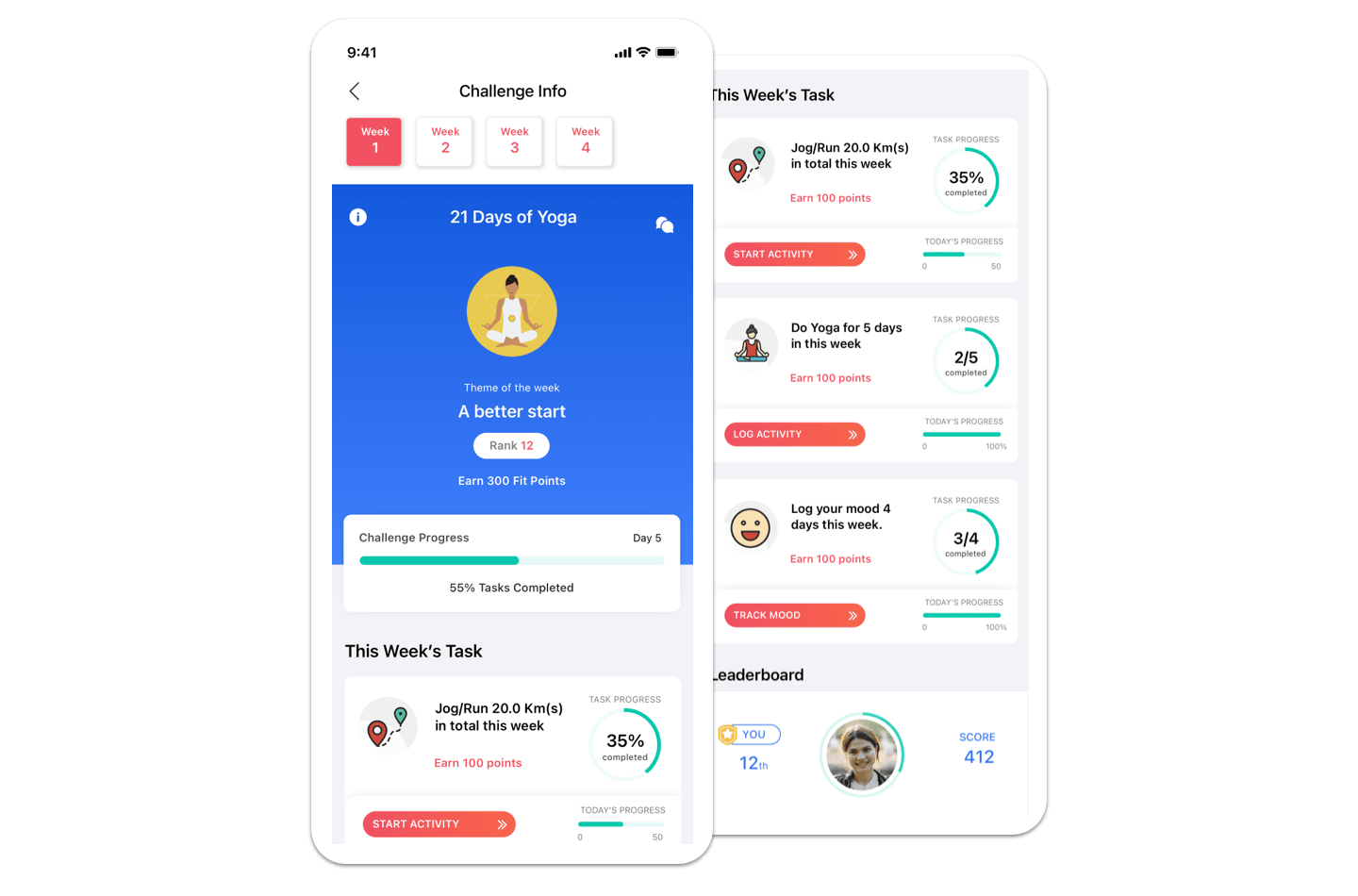
During the 2025 Wipro Wellbeing Fest challenge, 163 active participants collectively logged 8,870 squats alongside 1,980 mindfulness minutes. Building on this momentum, Wipro expanded the program into the Spirit of Wipro Step-a-thon, where 550 participants logged 12,236 squats, driving a 37.94% increase in squat participation.
Similarly, in IBS Software's 28-day March to Fitness challenge, 98 employees engaged in structured squat activities as part of an overall program that achieved an 88% engagement rate.
"From a corporate perspective, Vantage proved to be a powerful tool with its intuitive features like activity tracking, goal setting, and real-time leaderboards. Customized challenges added an element of fun and healthy competition. Overall, it has been a fantastic initiative, fostering a sense of community within Avalon."
– Shubham Sanghavi, Consultant, Avalon Consulting
How to perform a squat with proper form
Executing squats with proper biomechanics ensures maximum muscle recruitment while protecting your knees, hips, and lower back from strain.

Follow this step-by-step checklist to maintain correct form:
- Stance Setup: Stand with your feet shoulder-width apart, toes pointed slightly outward (about 10 to 15 degrees), chest open, and shoulders drawn down and back.
- Brace Your Core: Engage your abdominal wall as if preparing for impact. Maintain a neutral spine without arching or rounding your lower back.
- Initiate the Hip Hinge: Push your hips backward slightly before bending your knees, shifting your body weight into your midfoot and heels.
- Descent: Lower your body under control until your thighs are parallel to the floor (or as deep as your hip mobility comfortably allows without rounding your lower back).
- Knee Alignment: Ensure your knees track in the same direction as your toes. Do not allow your knees to cave inward during the descent or ascent.
- Ascent: Drive through the floor with your heels and midfoot, exhaling as you extend your knees and hips to return to the starting upright posture. Squeeze your glutes at the top.
Form Tip: Never sacrifice form for repetition count. If your heels lift off the ground or your lower back rounds, reduce your squat depth slightly until hip and ankle mobility improve.
The complete 30-day squat challenge workout plan
This 30-day progression balances volume increases with strategic rest days to allow muscle fibers to recover and rebuild. Each week introduces fresh exercise variations to challenge different movement angles and keep engagement high.
| Day | Primary Exercise Focus | Target Repetitions / Sets | Training Objective |
|---|---|---|---|
| Day 1 | Basic Bodyweight Squats | 15 reps (3 sets of 5) | Form baseline and movement calibration |
| Day 2 | Glute Kickback Squats | 20 reps (10 per side) | Glute activation and single-leg stability |
| Day 3 | Basic Squats + Kickbacks | 30 reps (15 Basic + 15 Kickbacks) | Progressive volume combination |
| Day 4 | Basic Squats + Kickbacks | 40 reps (20 Basic + 20 Kickbacks) | Muscular endurance build |
| Day 5 | Sumo Squats (Wide Stance) | 25 reps (3 sets of 8–9) | Adductor and inner thigh recruitment |
| Day 6 | Rest Day | Active recovery (light walking / stretching) | Muscle repair and glycogen replenishment |
| Day 7 | Basic Squats + Sumo Squats | 40 reps (20 Basic + 20 Sumo) | Week 1 consolidation test |
| Day 8 | Pulse Squats + Sumo Squats | 35 reps (15 Pulse + 20 Sumo) | Time-under-tension and quad burn |
| Day 9 | Jump Squats + Basic Squats | 35 reps (15 Jump + 20 Basic) | Plyometric power and fast-twitch activation |
| Day 10 | Sumo Squat with Toe Raises | 40 reps (2 sets of 20) | Calf and ankle stabilizer integration |
| Day 11 | Rest Day | Rest & hydration focus | Connective tissue recovery |
| Day 12 | Bulgarian Split Squats | 30 reps (15 per leg) | Unilateral balance and quad isolation |
| Day 13 | Basic + Sumo + Bulgarian | 50 reps (20 Basic + 20 Sumo + 10 Split) | Multi-planar endurance circuit |
| Day 14 | Narrow Squats | 40 reps (2 sets of 20) | Outer quad sweep development |
| Day 15 | Side-to-Side Lateral Squats | 30 reps (15 per side) | Frontal plane mobility and hip health |
| Day 16 | Midpoint Milestone Hold | Max isometric squat hold (timed test) | Mental grit and isometric quad stamina |
| Day 17 | Rest Day | Gentle yoga and hip opener stretches | Mid-challenge restorative recovery |
| Day 18 | Side Squats + Narrow Squats | 50 reps (25 Side + 25 Narrow) | Lateral and sagittal strength pairing |
| Day 19 | Sumo Squats + Glute Kickbacks | 60 reps (30 Sumo + 30 Kickbacks) | Volume acceleration |
| Day 20 | Narrow Squats + Pulse Squats | 60 reps (30 Narrow + 30 Pulse) | Hypertrophic stamina conditioning |
| Day 21 | Pulse Squats + Basic Squats | 70 reps (35 Pulse + 35 Basic) | Week 3 peak volume challenge |
| Day 22 | Jump Squats + Basic Squats | 75 reps (25 Jump + 50 Basic) | Cardiovascular and muscular power |
| Day 23 | Rest Day | Deep breathing and mobility walks | Recovery before the final sprint |
| Day 24 | Narrow Squats + Wall Sits | 60 Narrow Squats + 45s Wall Sit | Dynamic and isometric fatigue resistance |
| Day 25 | Bulgarian Squats + Pulse Squats | 70 reps (35 Split + 35 Pulse) | Unilateral leg pump |
| Day 26 | Centennial Milestone | 100 Basic Squats (broken into sets) | 100-rep psychological and physical milestone |
| Day 27 | Rest Day | Active recovery and hydration | Full restorative rest |
| Day 28 | Sumo Squats + Basic Squats | 110 reps (50 Sumo + 60 Basic) | Master volume test |
| Day 29 | Side Squats + Bulgarian Squats | 80 reps (40 Side + 40 Split) | Total lower-body stabilization |
| Day 30 | Grand Finale Circuit | 100 Squats + Max Timed Wall Sit | Challenge completion and habit mastery |
How to sustain consistency across 30 days
Building a new physical habit requires removing cognitive friction. Corporate wellness habit specialist Ashish Kumar Jha highlights how structured challenges create lasting behavioral shifts:
"Once you build the habit, all these excuses vanish very quickly: 'I don't have time,' 'I have distractions,' 'I don't have the resources.' Zero cognitive load. You don't need a reminder."
– Ashish Kumar Jha, Co-founder & CEO, Vani
To maximize your results during the 30 days:
- Schedule a Fixed Workout Window: Perform your daily squat sets at the same time each day (e.g., right before your lunch break or as a mid-afternoon energy reset).
- Break Repetitions into Sets: You do not need to perform all 60 or 100 reps in one go. Splitting volume into manageable sets of 15 to 25 reps prevents form breakdown.
- Stay Hydrated and Nourished: Adequate protein intake and hydration support rapid muscle repair and reduce delayed-onset muscle soreness (DOMS).
How to track squats automatically with Vantage Fit
Manual logging often leads to forgotten entries and inconsistent participation data. Vantage Fit eliminates manual friction by leveraging on-device computer vision and AI pose detection through your smartphone's front camera.
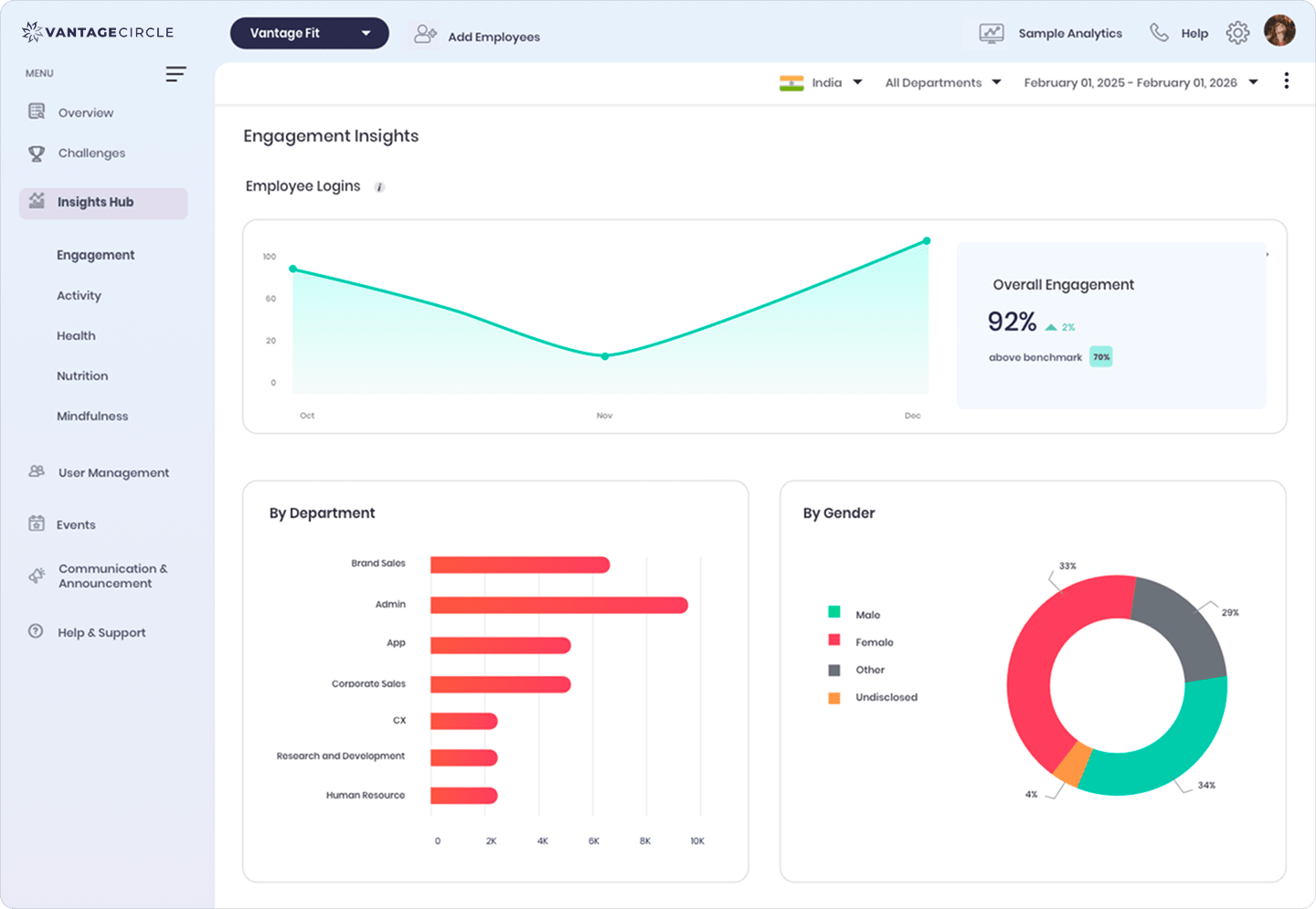
The automated tracking engine operates seamlessly in four steps:
- Position Your Smartphone: Place your phone against a water bottle or desk stand at floor level, tilting the front camera toward your workout area.
- Body Frame Calibration: Step back 5 to 7 feet until your full skeletal profile fits inside the on-screen boundary guide. The alignment reticle turns green once your joint keypoints (shoulders, hips, knees, ankles) are recognized.
- Real-Time Rep Detection: Perform your squats smoothly. The AI pose model dynamically tracks knee flexion and hip descent, validating reps only when your thighs reach parallel depth. Auditory and visual cues provide instant rep confirmation.
- Instant Score & Reward Syncing: Completed reps instantly update your personal dashboard rings, contribute to active campaign targets (such as daily streak milestones), update company-wide leaderboards, and award redeemable Vantage Points.
Frequently Asked Questions
How many squats should a beginner do per day?
Beginners should start with 15 to 25 bodyweight squats per day, broken into 2 to 3 manageable sets of 8 to 10 repetitions. As strength and mobility improve over two weeks, daily volume can gradually increase to 40 to 60 repetitions.
What does doing the 30-day squat challenge do to your body?
A 30-day squat challenge builds muscular tone in your quadriceps, glutes, hamstrings, and calves while strengthening core stabilizers. It also counteracts the negative effects of prolonged sitting by improving hip mobility, increasing blood circulation, and boosting resting metabolic rate.
Why are rest days necessary during a squat challenge?
Rest days allow microscopic muscle tears created during exercise to repair, adapt, and grow stronger. Skipping rest days can lead to cumulative muscle fatigue, tendon strain, and diminished performance.
Can you perform the 30-day squat challenge at work without equipment?
Yes. The 30-day squat challenge is entirely bodyweight-based and requires zero equipment or large gym spaces. Employees can complete their daily sets beside their office desk, in conference rooms, or in home workspaces during brief workday breaks.
How does Vantage Fit track squat repetitions automatically?
Vantage Fit utilizes computer vision and AI pose detection via your smartphone's front-facing camera. The app identifies key skeletal joints, monitors hip descent depth, counts validated repetitions automatically, and logs results directly to challenge leaderboards.
Summing it up
Completing a 30-day squat challenge is one of the most effective, accessible ways to revitalize your physical health, enhance lower-body strength, and establish consistent daily exercise habits.
For organizations, launching a structured squat challenge fosters a vibrant workplace fitness culture where employees support one another, share achievements, and enjoy a healthier, more active working environment.