
Do employees really feel taken care of at work? Roughly one in four US employees strongly agrees that their organization cares about their overall wellbeing, according to Gallup. At the start of the pandemic that figure peaked at 49%. It has since fallen back to where it sat in 2014, which means the gains of 2020 have been fully given back.
The wider picture is no kinder. Gallup's State of the Global Workplace 2026 report puts global employee engagement at 20% in 2025, its lowest level since 2020. Employee wellbeing did improve for the first time in three years, with 34% of employees now classified as thriving, but that still leaves two thirds who are not.
Most organizations are not short of wellness initiatives. What they are short of is evidence about which ones their people actually need. That is the gap an employee wellbeing survey closes: it replaces assumptions about your workforce with what your workforce tells you.
This guide covers what a wellness survey is, how to run one people answer honestly, the questions to ask across nine categories, and how to turn the results into something that changes.
KEY TAKEAWAYS
- Employee wellness surveys assess physical, mental, financial, and social wellbeing across the entire workforce in one structured exercise.
- Effective surveys cover 9 categories, from physical health and stress to career development, financial wellness, and work culture.
- Decide what you will do with the answers before you write a single question. A survey with no plan behind it collects data nobody uses.
- Anonymity and leadership buy-in are critical for honest, actionable results; without them, participation and response quality drop.
- Mix closed questions, which give you trend lines, with open-ended ones, which tell you why the numbers moved.
- Segment and prioritize findings before acting: identify the lowest-scoring areas first and set measurable goals for improvement.
- Reporting back matters most. Asking about wellbeing and then doing nothing visible damages trust more than never asking at all.
- Platforms like Vantage Fit automate the feedback loop with built-in eNPS surveys, post-challenge feedback, and a real-time wellness score dashboard.
What is an Employee Wellness Survey?
In simplest terms, an employee wellness survey is a questionnaire through which employers can assess the overall well-being of their employees. It is a simple yet formidable tool that measures physical and mental well-being, boosts job satisfaction, effectuates wellness programs, and improves company reputation.
Wellness survey questions are incredibly effective for team leaders and managers to learn about the team.
They can find areas within the team that are lagging and help troubleshoot them. They also majorly help HRs be aware of health conditions that any employee might have.
Wellness surveys also help improve the current wellness programs, if any. They raise the morale of the workforce by demonstrating that their company cares for their health and wellness. They can be conducted quarterly, biannually, or annually.
Let's dive deeper into the subject matter and ask a few questions!
Wellness Surveys vs. Engagement Surveys
Wellness and engagement surveys are sometimes used interchangeably but they are different from each other. Wellness surveys assess the well-being of the employees like stress levels, moods, weight, etc.
Conversely, engagement surveys focus more on the employees' attitudinal aspects like job satisfaction, alignment with the organizational structure, and others.
One more piece of terminology, because it causes confusion in HR conversations and in vendor demos. An employee wellbeing survey and an employee wellness survey are the same instrument. "Wellbeing" tends to be the preferred term in the UK and across Europe, "wellness" in the US. Some teams use "wellbeing" for the broader picture and "wellness" for the physical dimension inside it, but there is no formal distinction, and the two words are used interchangeably in practice. Whichever you call it, the design principles below are identical.
How to Run an Employee Wellbeing Survey
Most wellness surveys fail before the first question is written, because nobody agreed what the answers were for. Work through these steps in order.
1. Decide what you will do with the results
Write down the decision the survey is meant to inform. Are you choosing between two benefit options? Setting next year's wellness budget? Finding out why one department's absence rate is double the rest? A survey with a decision attached to it produces questions worth asking. A survey run because it is that time of year produces a spreadsheet nobody opens.
If you cannot name the decision, do not run the survey yet.
2. Choose your categories, and fewer than you think
The nine categories below are a menu, not a checklist. Pick the three or four that map to the decision from step 1. A focused survey on stress and workload will tell you more than a shallow sweep across all nine, and it takes a quarter of the time to complete.
3. Write closed and open-ended questions together
Closed questions give you something to trend. Ask the same rating question every cycle and you can see movement. Open-ended questions tell you why the number moved, and they surface issues you would never have thought to ask about.
A workable ratio is roughly five closed questions to one open-ended one. Fewer open questions than that and you get numbers with no explanation. Many more and completion rates drop, because free-text answers are work.
4. Keep your scales consistent
Pick one scale per section and stay on it. Switching between a five-point agreement scale, a ten-point rating, and yes/no answers inside the same section makes the survey harder to complete and the results harder to compare. It also quietly damages your data: people answer a scale they have misread.
If you plan to track results over time, do not change the wording or the scale of a question between cycles. The moment you do, your trend line stops being a trend line.
5. Pilot it with a small group
Send it to eight or ten people first. You are looking for questions they read twice, options that do not fit their situation, and anything that made them hesitate. Fix those, then send it wide. This step takes a day and it is the difference between usable data and a survey you have to re-run.
6. Secure leadership support before you launch
Leadership buy-in is not a formality. It signals that the organization takes the exercise seriously, it lifts participation, and it means the findings have somewhere to go. Without it, you collect evidence of problems nobody has agreed to fix.
7. Make it anonymous, and say so clearly
Confidentiality is what makes honest answers possible, particularly on mental health, financial stress, and anything involving a manager. State plainly how responses are collected, who sees them, and at what group size results are reported. If your team is small enough that demographic filters could identify individuals, say that you will not break results down that far.
8. Announce it, and time it deliberately
Tell people what the survey is for, how long it will take, and when they will hear back. Choose a window that avoids your busiest period and a time of day when people are not rushing. Decide the frequency too: quarterly, biannual, or annual. More often is not better.
9. Avoid survey fatigue
Fatigue sets in when people are asked frequently and see nothing change. The cure is fewer, better surveys with visible follow-through, not shorter ones. If you already run an engagement survey, consider whether wellbeing questions belong inside it rather than as a separate exercise.
10. Report back and act, even on the uncomfortable findings
This is the step organizations skip, and it is the most damaging one to skip. Asking employees for personal information about their stress, health, and finances, and then producing nothing visible, is worse than not asking. It confirms that the exercise was theatre.
Share what you found, including the parts that do not flatter the organization. Name what you are going to do about it, what you are not going to do and why, and when you will check again.
"The key is ask the population. Take statistics. Get feedback. Check in often. And don't put all your budget in one basket."
Alyssa Poggioli, Corporate Health & Wellness Consultant | Listen to the full episode
Questions to Ask in an Employee Wellness Survey
A survey is conducted with some objective in mind. That objective can be efficiently achieved with both open-ended and closed-ended questions. Here are some examples of questionnaires you ask in an employee survey.
Each category below leads with closed questions, which are the ones you trend over time, and closes with at least one open-ended question, which is where the explanation lives. Take the categories that match your objective rather than using all nine.
Physical Wellness
How would you rate your overall physical health? (e.g., Excellent, Good, Fair, Poor)
How often do you engage in physical activity (e.g., exercise, sports, walking)? (e.g., Daily, Weekly, Occasionally, Rarely/Never)
Do you feel you have sufficient energy throughout the workday?
Do you feel that your workload impacts your physical health? (e.g., Yes, frequently; Sometimes; Rarely; Never)
How often do you experience physical discomfort (e.g., back pain, eye strain, fatigue) due to work-related activities?
Does your work schedule allow time for physical activity during the day? (e.g., Yes, often; Sometimes; Rarely; Never)
What would make it easier for you to look after your physical health during the working week? (Open-ended)
Read more on: 20 Healthy Office Habits to Boost Your Well-being in 2026
Stress and Mental Health
What are your primary sources of work-related stress? (e.g., Deadlines, workload, team dynamics, lack of resources, unclear expectations)
Do you feel your current workload is manageable? (Yes/No/Somewhat)
How often does work-related stress impact your personal life? (e.g., Frequently, Occasionally, Rarely, Never)
Do you feel comfortable discussing mental health challenges with your manager or HR? (Yes/No/Unsure)
Are you aware of the mental health resources and support available at work? (Yes/No)
How would you rate the organization's efforts to support mental health? (e.g., Excellent, Good, Fair, Poor)
If you could change one thing about how work affects your stress levels, what would it be? (Open-ended)
Read more on: Employee Wellness and Stress Management: A Complete Guide for HR
Workload and Work-Life Harmony
Is the current workload allowing you time for yourself? (e.g., Yes, No/Somewhat)
Do you think you manage your work stress well? (e.g., agree/disagree)
Do you feel supported at work by your teammates and manager? (e.g., agree/disagree)
Would you rather work remotely or in the office?
Do you feel you have achieved personal and career growth working with us? (e.g., Yes, No/Up to an extent)
What gets in the way of you finishing your work within your contracted hours? (Open-ended)
Employee Needs and Interests
Do you feel you are getting enough exposure to upskill and refine yourself? (e.g., yes/no)
What skills or areas of expertise would you like to develop further? (Open-ended)
How satisfied are you with the current training and development programs? (e.g., Very satisfied, somewhat satisfied, Neutral, Dissatisfied)
Do you feel that your teammates and manager value your ideas and opinions? (e.g., yes/no)
Are there any hobbies or interests you want the organization to support? (open-ended)
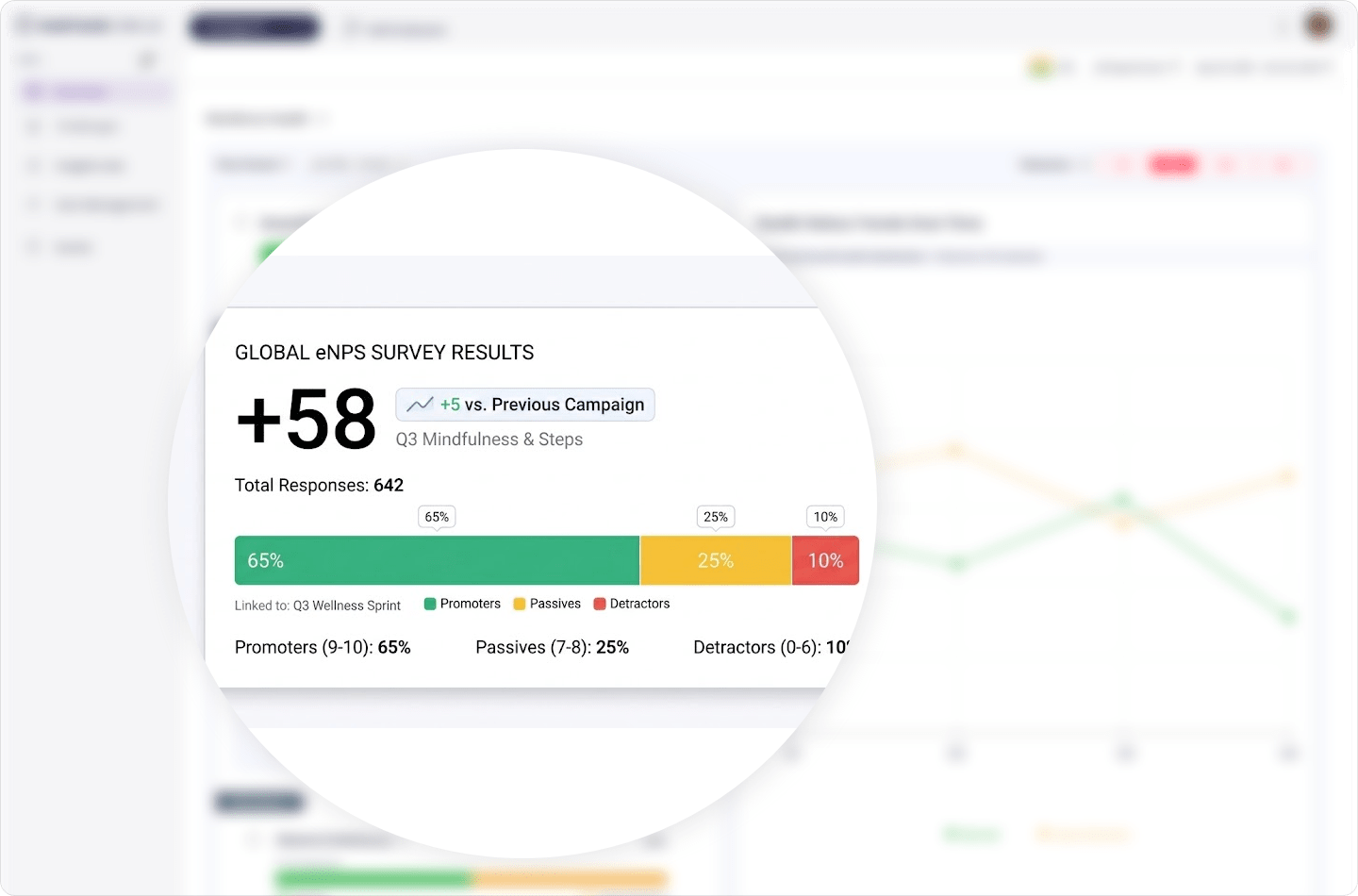
Understanding how employees genuinely feel is the foundation of any effective wellness program. Platforms like Vantage Fit include built-in eNPS (Employee Net Promoter Score) surveys and post-challenge feedback tools that let HR teams capture sentiment at scale, right after challenges, campaigns, or key milestones. Combined with a real-time wellness score dashboard, these tools turn raw responses into actionable data, helping leaders identify at-risk groups, track progress over time, and make informed program decisions.
In Brazosport ISD's Fit Wars campaign, the organization recorded an organisational mood score of 4 out of 5, a result driven by consistent feedback collection throughout the 2-week challenge.
Financial Wellness
Do you feel financial stress affects your job, health, or relationships? (e.g., yes, no/somewhat)
What employee benefits do you think would help you reduce concerns about money? (open-ended)
How often have you been worried about the rising cost of living in the past week?
How satisfied are you with your compensation and benefits? (e.g., Very, Somewhat/Not at all)
Do you feel the company supports your financial well-being very well? (e.g., yes, no/somewhat)
Read more on: Financial Stress: A Big Deterrent on Employee Wellness and Work
Social Wellness
Do you think you have a good relationship with your teammates? (e.g., yes, no/somewhat)
Do you feel the company communication is transparent and open? (e.g., yes, no/somewhat)
Do you feel supported by your team when facing challenges? (e.g., yes, no/somewhat)
Do you feel anxious sharing your opinions or show any signs of social anxiety? (e.g., yes, no/somewhat)
Are team roles and responsibilities clear to everyone? (Yes/No/Somewhat)
What would help you feel more connected to your colleagues? (Open-ended)
Read more on: 27 Fun Social Wellness Activities to Boost Team Spirit at Work
Work Culture
How well do the organization's culture and policies align with your personal goals?
Do you feel diversity and inclusion are valued by the organization?
Do you feel well-informed about organizational goals, priorities, and changes? (Yes/No/Somewhat)
Do you feel teamwork is encouraged and valued within the organization? (Yes/No/Somewhat)
How would you rate the approachability and supportiveness of leadership? (e.g., Excellent, Good, Fair, Poor)
Is there any aspect of work culture that negatively affects you? (Open-ended)
Read more on: 9 Ways to Create a Healthy Work Environment to Improve Employee Health
Career Development
Do you have a clear career path within the organization? (Yes/No/Somewhat)
Do you receive regular feedback on your performance for growth? (Yes/No/Somewhat)
Do you feel your current role aligns with your long-term career goals? (Yes/No/Somewhat)
How often do you have performance reviews with your reporting manager? (e.g., Annually, Quarterly, Rarely, Never)
How well does your company communicate new opportunities for training and development?
What support would help you move toward your next role here? (Open-ended)
Health and Wellness Facilities
On a scale of 1 to 10, how well do you feel your organization cares for your health?
Do you have access to your organization's wellness facilities, such as yoga and a gym?
If yes, how often do you utilize these facilities?
Do you think the wellness facilities offered address all the employees' needs?
How satisfied are you with how wellness programs are run here? (e.g., Very satisfied, Somewhat satisfied, Neutral, Dissatisfied)
How often do you participate in the wellness programs in your organization?
Do you think the wellness programs offered are enough for the time being?
What wellness benefit would you use that we do not currently offer? (Open-ended)
Read more on: Wellness Room at Work: Meaning, Benefits, Ideas & How to Design
How to Interpret the Results of Employee Wellness Surveys?
The results of a wellness survey can provide various insights into the health and well-being of the company. However, to get the most out of these results, one must be able to interpret them correctly.
Data Segmentation and Visualization
Segmenting the data obtained fosters a clear understanding of the survey. It helps prepare reports for presentations and analyze them in the future. Here are some ways to segment and visualize the data:
Quantitative Data: This data is the average of scores on each question, the average age group in the organization, and other numerical figures that were mentioned in the survey. The numerical figures also help determine any trends in the organization.
Qualitative Data: This data is relatively hard to interpret as it includes grouping similar comments, recognizing the tone of employees from the answer, and spotting sentiments.
Prioritization of Key Findings
It is crucial to prioritize key findings and evaluate them. Determining the aspects that received the most negative comments, or low scores can pinpoint issues in the organization.
Developing Action Plans
Once the analysis and segmentation are done, an action plan must be devised to tackle the issues. Define specific, measurable, and achievable goals for addressing the problems identified.
For example, if stress levels are high, mindfulness training or workload adjustments should be introduced. Similarly, flexible hours can be introduced to improve work-life balance.
Read more on: Corporate Wellness Programs: 4 Case Studies + 19 Ideas for HR Leaders
Comparing Results Between Cycles
A single survey tells you where you stand. Two comparable surveys tell you whether anything you did worked, which is the more useful question.
To keep cycles comparable, keep the wording and scale of your core questions fixed, run the survey at a similar point in the business calendar, and note anything that changed in between, such as a restructure or a new benefit. When participation shifts significantly between cycles, check that before reading anything into the scores: a jump from 40% to 75% participation changes who is in your sample, not just how many.
If you want to go further than survey scores alone, pair them with the operational measures your organization already collects. Absence rates, program participation, and turnover in specific teams either corroborate what people told you or raise a question worth chasing.
Read more on: Why Your Employee Wellness Program Needs Evaluation: Importance, Types & Steps to Conduct
Incentivizing Participation
Offer employees something in return for taking part. If nothing monetary is available, recognition on an organizational platform like Vantage Circle can be encouraging, and it lifts response rates. Keep the incentive tied to completion rather than to the content of anyone's answers, so it never reads as buying a particular response.
Bear in mind that financial wellness questions and mental health questions are the two areas where employees are most reluctant to answer honestly. If either is central to your objective, invest the effort in the anonymity guarantee from step 7 rather than in a larger incentive.
Frequently Asked Questions
Why are employee wellness surveys important?
Employee wellness surveys are essential for assessing an organization's employees' physical, mental, emotional, and financial well-being.
What questions should I ask in a wellness survey?
You should ask a variety of questions, both open-ended and closed-ended. Diversity of questions ensures more authentic results.
How do you measure employee wellness?
Employee wellness can be measured through metrics like employee engagement, absenteeism rates, etc.
How do you ask an employee about their well-being?
You can conduct employee wellness surveys to assess employees' well-being. These surveys are powerful tools for determining how well an organization as a whole is functioning.
What is the difference between an employee wellbeing survey and an employee wellness survey?
There is no formal difference; the two terms describe the same instrument. "Wellbeing" is the more common term in the UK and Europe, "wellness" in the US. Some HR teams use "wellbeing" for the whole picture and "wellness" for the physical dimension within it, but the distinction is a matter of house style rather than methodology.
What is an employee wellbeing pulse survey?
A pulse survey is a short, frequent check-in, usually three to five questions run monthly or quarterly, rather than a full annual questionnaire. Pulse surveys are good for tracking whether a specific measure is working and for catching problems early. They are not a substitute for a full survey, because they are too short to cover all nine wellbeing categories.
How many questions should an employee wellbeing survey have?
Aim for a survey people can finish in five to ten minutes, which usually means 15 to 25 questions. Coverage matters less than completion: a focused survey on the three categories tied to your objective will produce more usable data than a long sweep across all nine that half the workforce abandons.
How often should you run an employee wellbeing survey?
Annually or biannually for the full survey, with shorter pulse checks in between if you need them. The right frequency depends less on headcount than on your capacity to act. Do not run a survey more often than you can visibly respond to, because asking without follow-through is what causes survey fatigue.