
Introduction
The best remote employee wellbeing platform is the one that matches your dominant problem. Vantage Fit fits gamified challenges from about $1 per user per month. Headspace for Work fits burnout, Wellhub fits gym access, BetterUp fits coaching, and Donut fits isolation.
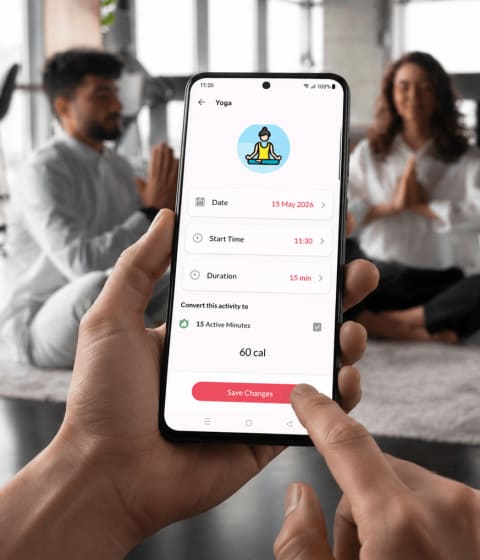
Vantage Fit is a corporate wellness platform that runs gamified, asynchronous fitness challenges and rewards across time zones for companies with 500 to 10,000+ employees. It syncs with Apple Watch, Fitbit, Garmin, Google Fit, and Samsung Health, and it pushes nudges into Slack and Microsoft Teams.
Key Takeaways
- Pricing across these ten platforms runs from under $1 to $50 or more per employee per month, so scope matters far more than sticker price.
- Gallup found fully remote workers are the most engaged group at 31%, yet only 36% are thriving in life overall.
- Gallup also found 57% of fully remote workers are job hunting, dropping to 38% when they are both engaged and thriving.
- A platform has to work asynchronously, or it only ever serves the employees who share headquarters hours.
- Run a 30-day pilot with one department and watch weekly active users before you commit company-wide.
Remote work is now a permanent operating model, not a pandemic workaround. The flexibility is real. So are the structural risks to wellbeing that most companies still underestimate.
The old phrase “out of sight, out of mind” has become a real management risk in distributed teams. But this isn’t just about physical absence; it’s about emotional disconnection. The data now confirms what HR leaders have suspected for years: remote work has created a measurable wellbeing crisis. According to Buffer’s 2023 State of Remote Work report, 23% of remote workers struggle with loneliness and 22% struggle to unplug.
Gallup’s May 2025 analysis calls it a paradox, and the numbers back it up. Fully remote workers are the most engaged group at 31%, against 23% for hybrid and 23% for on-site remote-capable staff. Yet only 36% of fully remote workers report thriving in life overall, against 42% for both of those groups.
Stress tracks the same way for anyone away from a desk. In the same Gallup analysis, 45% of fully remote and 46% of hybrid workers report significant daily stress, against 39% and 38% for on-site staff. Engagement and wellbeing have come apart. Closing that gap is the job a remote wellbeing platform actually has.
For a wider view of enterprise platforms judged on engagement model, HRIS integration, and analytics depth, see our comparison of the best digital wellness platforms for HR teams.
10 best wellbeing platforms for remote teams at a glance
How we chose these 10 platforms
We started from the platforms HR teams actually shortlist for distributed workforces, then applied three gates. Anything that failed a gate was cut, however well known it is.
- Asynchronous participation: employees must be able to take part on their own clock, with no live session or fixed hour required.
- Mobile-first and location-independent: the full experience has to work from a phone, with no on-site component an employee can miss out on.
- Disclosed pricing or a stated pricing model: we list a real number wherever the vendor publishes one, and say “on request” where it does not, rather than guessing.
That ruled out live-only class providers, single-country gym networks, and clinical services sold purely through brokers. It also means this is a shortlist, not a market census.
The table below compares all ten on the two things that decide adoption in a distributed team: how employees take part, and what it costs. Live-only formats fail the moment half your team is asleep.
| Platform | Best for | How employees take part | Pricing |
|---|---|---|---|
| Vantage Fit | Gamified challenges and leaderboards | Anytime, challenges run over weeks | ~$0.67 to $2.08 per employee/month |
| Headspace for Work | Mental health and burnout | Anytime, on-demand audio and video | $5.83 per user/month |
| Wellhub (Gympass) | Gym access plus digital apps | Anytime digital, plus in-person gyms | From as low as $1 to $50 per employee/month |
| Wellable | Custom challenge design | Anytime, with text-message nudges | $1.25 per user/month, 25-user minimum |
| Donut | Social connection and onboarding | Scheduled 15 to 30 minute pairings | Free tier, Standard from $74/month |
| Calm for Business | Sleep and anxiety | Anytime, on-demand audio | ~$70 per license/year |
| Thrive Global | Ending always-on culture | Anytime, 60-second resets | Custom |
| BetterUp | Coaching and retention | Scheduled 1:1 coaching sessions | $99 per 30-minute session |
| Nectar | Peer recognition | Anytime, social recognition feed | On request |
| WellSteps | Structured, compliant programs | Anytime, photo-verified activities | On request |
Vantage Fit : Best for gamified fitness challenges and global leaderboards. Unlimited challenges from about $0.67 per employee per month at 1,000 staff.
Headspace for Work : Best for mental health, stress, and burnout prevention. $5.83 per user per month.
Wellhub (Gympass) : Best for distributed teams that want local gyms plus digital apps. Entry, Full, and Premium plans from as low as $1 to $50 per employee per month.
Wellable : Best for HR teams that want to design their own challenges. $1.25 per user per month, 25-user minimum.
Donut : Best for breaking silos inside Slack and Microsoft Teams. Free tier, Standard from $74 per month billed annually.
Calm for Business : Best for anxiety, sleep, and switching off after work. About $70 per license per year.
Thrive Global : Best for enterprises moving away from always-on culture. Custom pricing.
BetterUp : Best for leadership development and retaining remote talent. $99 per 30-minute session.
Nectar : Best for making remote wins visible through peer recognition. Pricing on request.
WellSteps : Best for structured, compliant programs with hands-off HR management. Pricing on request.
What makes a wellbeing platform remote-ready?
A remote-ready wellbeing platform is one where an employee in Manila gets the same experience as an employee two floors below the CHRO. That comes down to five things: asynchronous access, mobile-first design, global reach, workflow integration, and private-by-default data. Treat these as gates, not nice-to-haves.
Asynchronous participation : Employees join on their own clock. A live 9 a.m. Zoom yoga class is a benefit for one office and a 2 a.m. alarm for everyone else.
Mobile-first design : Most remote employees will open a wellness app on a phone, not a laptop. If the mobile experience is clumsy, adoption dies in week two.
Global accessibility : Multiple languages, multiple currencies for rewards, and no dependency on a single country's gym network.
Workflow integration : Slack, Microsoft Teams, and your HRIS. Vantage Fit connects to Workday, BambooHR, and ADP, with Okta and SAML 2.0 for single sign-on.
Aggregate-only reporting : Individual health data must stay private to the employee. HR should see population-level trends, never one person's numbers.
What do hybrid teams need that fully remote teams do not?
Hybrid teams need location-neutral scoring, one shared leaderboard, and perks that reach the home as easily as the office. Remote programs fail on time zones. Hybrid programs fail on fairness, because anything that rewards office attendance quietly tells home-based staff the program is not for them.
In a hybrid setup, wellbeing is a proximity problem. Gallup’s data shows hybrid workers report the highest daily stress of any group at 46%, just above fully remote staff at 45%. Anything that quietly favors the people in the building will widen that gap. Our guide to work from home burnout covers the warning signs managers miss.
Location-neutral scoring : The moment a challenge rewards office attendance, home-based employees stop competing. Score on individual effort, like steps or active minutes, not on showing up.
One leaderboard, not two : Splitting office and remote employees into separate boards formalizes the divide. A single team leaderboard keeps both groups in the same game.
Equal access to perks : An on-site gym or catered lunch is invisible to half a hybrid workforce. Digital-first benefits and redeemable reward points travel to everyone.
Visibility for remote wins : In hybrid teams, in-office work gets seen more often. A public recognition feed corrects for that bias without a manager having to remember.
Remote work is not the problem. Outdated wellbeing strategies are.
Traditional wellness programs were built for a building. Gym subsidies tied to one location and on-site yoga collapse the moment your workforce goes global. So this is not a wellbeing problem caused by remote work. It is a benefits design problem that remote work exposed.
The 2026 figures below come from the 2026 Remote Work Well-Being Survey from CoworkingCafe, which collected 1,140 valid responses between June and October 2025.
For more on the mental-health side of this, see our guide to the mental health of remote workers.
Isolation and loneliness : Buffer's figure above came from 3,000 remote workers. CoworkingCafe's 2026 survey found 20% of Gen Z remote workers feel lonely at high frequency. Without watercooler moments, employees work in psychological silos.
The always-on trap : CoworkingCafe's 2026 survey found 58% of remote workers feel at least some pressure to stay available. Without a commute, work bleeds into nights and weekends.
Burnout that nobody logs : CoworkingCafe's 2026 survey of 1,140 remote workers found 33% had burnout symptoms, rising to 38% among Gen Z. Nobody walks past a burned-out remote employee's desk.
Makeshift ergonomics : Kitchen tables and couches replace adjustable chairs. Sedentary hours climb because the shortest walk of the day is to the fridge.
A support gap : In the same 2026 survey, only 59% of employees said their workplace offers any form of mental-health support. Four in ten have nothing to reach for.
10 wellbeing platforms built for remote and hybrid work

Vantage Fit
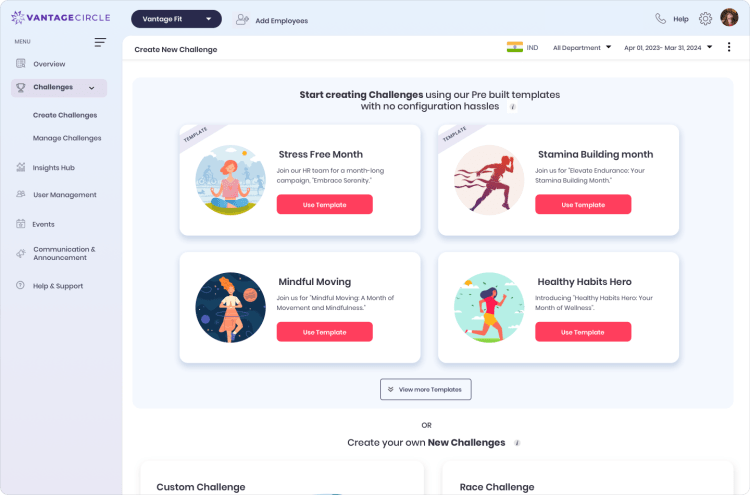
A gamified corporate wellness platform built to drive daily participation across fully distributed teams. Challenges run for weeks rather than at fixed hours, so nobody has to set an alarm to take part.
Remote fit: fully asynchronous, mobile-first, and reward points redeem against global gift-card brands, so an employee in Berlin gets the same payoff as one in Boston.
Remote-work standout features:
- Global leaderboards: employees in London, New York, and Tokyo compete on the same step board, which creates one shared space instead of regional pockets.
- Virtual marathons: location-agnostic events where a team covers a distance together, wherever each person physically is.
- Asynchronous challenges: multi-week formats that fit around a person’s time zone, school run, or night shift.
- Aggregate-only analytics: an Org Wellness Score and department-level engagement views for HR, with individual health data kept private to the employee.
Integrations: Slack and Microsoft Teams for nudges. Workday, BambooHR, and ADP for HRIS. Active Directory, Okta, and SAML 2.0 for single sign-on. Apple Watch, Fitbit, Garmin, Google Fit, and Samsung Health for activity data.
Compliance: HIPAA compliant, SOC 2 Type II certified, ISO 27001 certified, and GDPR compliant with EU data residency options. That last point matters if your remote team spans the UK and Europe.
Recommended for: Companies that want daily participation from a distributed workforce through gamified challenges and leaderboards.
G2
4.5/5 ⭐️
Capterra
4.5/5 ⭐️ (97 reviews)
App Store
4.2/5 ⭐️
Google Play
4.5/5 ⭐️
Activity tracker (steps, distance, calories)
Heart rate tracking and mood logging
Customizable corporate challenges (e.g., Walk to the Moon)
In-app redeemable gift cards for global brands
AI-based squat tracking via smartphone camera
Campaign-linked eNPS surveys and health risk assessment
Single Challenge (4 weeks)
Basic and Pro tiers, from ~$6 per employee at 500 staff
Unlimited Challenges
Basic from ~$0.67 to $1.67 per employee/month by headcount
Unlimited Challenges (Pro)
From ~$0.83 to $2.08 per employee/month by headcount
Over 1,000 employees
Custom pricing
Headspace for Work
Wellhub (Gympass)

Wellable
Donut
Calm for Business
Thrive Global
BetterUp
Nectar
WellSteps
How much does a remote employee wellbeing platform cost?
Expect anything from under $1 to $50 or more per employee per month across the ten platforms here. The spread is not about quality. It reflects whether you are buying software alone, software plus clinical services, or software plus a physical gym network.
| Price band | What you are buying | Examples from this list |
|---|---|---|
| Under $1 to ~$2 per employee/month | Gamified challenges, activity tracking, rewards, and admin analytics | Vantage Fit, Wellable, Wellhub Entry |
| ~$1 to $6 per employee/month | Mindfulness and mental-health content, usually quoted per year | Headspace for Work, Calm for Business |
| ~$10 to $50 per employee/month | Digital apps plus a global in-person gym network | Wellhub Full and Premium |
| Flat monthly fee per workspace | Small-team tools priced per workspace, not per head | Donut |
| Custom or on request | Enterprise behavior change, 1:1 coaching, full-service programs | Thrive Global, BetterUp, Nectar, WellSteps |
Two costs get missed at proposal stage. The first is currency and tax on a globally distributed headcount. The second is the internal time to run the program, which is why full-service options quote higher.
Build the number before you take a sales call. Our breakdown of corporate wellness program costs covers the line items, and the corporate wellness budget template gives you a sheet to fill in.
What wellness programs actually work for remote employees?
The remote wellness programs that work are multi-week step and activity challenges, streak habit challenges, virtual marathons, on-demand mindfulness, and peer recognition feeds. All five are scored over days or weeks, never at a fixed hour. That is what lets an employee in any time zone take part.
Program design decides adoption more than platform choice does. For a wider set of formats, see our roundups of virtual wellness programs and the best employee wellness apps.
Multi-week step and activity challenges : The highest-participation remote format. Employees log activity whenever they exercise, and a team leaderboard keeps it social without a shared calendar.
Streak and habit challenges : Daily hydration, sleep, or movement streaks. Small targets, visible progress, and no requirement to be online at the same time as anyone else.
Virtual marathons and team distance goals : A team covers a set distance together from wherever each person is. It gives remote teams a shared goal that an office does not have to host.
On-demand mindfulness, not live classes : A recorded 10-minute session gets used at 6 a.m. and 11 p.m. A live class gets used by whoever shares the organizer's time zone.
Peer recognition on a public feed : Asynchronous by design and the cheapest fix for invisibility. It also gives hybrid managers a record of remote contribution.
Anonymous pulse surveys before you buy anything : Ask whether the dominant struggle is isolation, burnout, or physical health. Buying before you ask is how companies end up with an unused app.
Outdated wellbeing strategies vs remote-ready solutions
Same budget, different design. Four swaps change outcomes for a distributed team. Replace the on-site social committee with virtual pairings, unlimited-leave messaging with calendar-level interventions, the office gym with wearable-synced tracking, and the noticeboard with a public recognition feed.
Combat isolation: Swap the on-site social committee for virtual pairings and team leaderboards that put people in the same activity without the same room.
End the always-on trap: Swap unlimited leave messaging for calendar-level interventions: shorter meetings, reset breaks, and explicit switch-off rituals.
Support physical health at home: Swap the office gym for wearable-synced tracking and movement nudges that work at a kitchen table.
Keep culture visible: Swap the noticeboard for a public recognition feed, so a remote win is as visible as one announced in a stand-up.
How do you choose a wellbeing platform for a remote team?
Choose a remote wellbeing platform in five steps. First confirm asynchronous access plus Slack, Teams, and HRIS integration, then poll employees on their dominant struggle. Decide between a single platform and a specialist stack, run a 30-day pilot with one department, and verify privacy and data residency before signing. Skipping step two is the most common reason a platform goes unused.
Choosing a wellbeing platform is not only a software decision. It signals to a distributed team that someone noticed them. Our guide to employee engagement in wellness programs covers what to do in the weeks after launch, which is when most programs quietly stall.
1. Check the tech and time fit : Confirm Slack, Microsoft Teams, and HRIS integration, and confirm that every activity can be completed asynchronously. Integration predicts adoption better than feature count.
2. Poll your people first : Run an anonymous survey asking whether the primary struggle is isolation, burnout, or physical health. Shortlist only platforms that solve the winning answer.
3. Decide single-platform or specialized : One contract covering challenges, rewards, and analytics is simpler to run. A specialist stack is better when one acute problem dominates, such as clinical burnout.
4. Run the 30-day pilot : Pilot with one department and watch weekly active users at day 30, not sign-ups. Stickiness is the only number that predicts year-two engagement.
5. Scrutinize privacy and data residency : Individual health data must never reach managers, only aggregated trends. If your team spans the UK or EU, confirm GDPR compliance and EU data residency in writing.
FAQs
Q. What is the best employee wellness platform?
A: No single platform wins. Vantage Fit fits gamified challenges from about $1 per user monthly, Headspace fits mental health, Wellhub fits gym access, and BetterUp fits coaching. Match the platform to your team's dominant problem.
Q. What are some good wellness programs for remote employees?
A: Virtual step challenges, streak habit challenges, virtual marathons, on-demand mindfulness, peer recognition, and team distance goals. The programs that work run over weeks rather than at fixed hours, so every time zone can join.
Q. What are some good wellbeing apps for employees?
A: Vantage Fit for activity and challenges, Headspace and Calm for mindfulness and sleep, Wellable for custom challenges, and Donut for connection inside Slack or Teams. All work on mobile without office access.
Q. What are some good wellbeing activities for remote workers?
A: Asynchronous step and hydration challenges, 60-second reset breaks before meetings, virtual coffee pairings, mood check-ins, and team leaderboards. Each takes under 15 minutes and needs no shared office hours.
Q. How much does a remote employee wellbeing platform cost?
A: From under $1 to $50 or more per employee per month. Gamified challenge platforms start near $1. Mindfulness content is usually quoted per year. Bundled gym network access runs $10 to $50 depending on tier.
Q. Do wellbeing platforms work for hybrid teams too?
A: Yes, if participation is asynchronous and location neutral. Hybrid programs break when they reward office attendance. Challenges scored on individual effort keep office and home employees on the same leaderboard.
Q. Which employee wellness tools work best for distributed teams?
A: Tools that work outside headquarters hours: wearable-synced activity tracking, multi-week challenges, on-demand mindfulness, and recognition feeds. Slack and Microsoft Teams integration predicts adoption better than feature count does.
Q. Why do remote workers report high engagement but low wellbeing?
A: Gallup found fully remote staff are the most engaged group at 31%, yet only 36% are thriving and 45% report significant daily stress. Engagement measures the work. Wellbeing measures the life around it.
Q. How do you measure ROI on a remote wellbeing program?
A: Track weekly active users first, then absenteeism, retention, and healthcare claims over 12 months. Gallup found 57% of fully remote workers are job hunting, falling to 38% when they are engaged and thriving.