
A workplace stair climbing challenge is a structured corporate wellness initiative that encourages employees to take the stairs instead of elevators over a designated timeframe (typically 30 days) to build cardiovascular stamina, strengthen lower-body muscles, and integrate moderate physical activity into daily work routines.
How often do we mindlessly reach for the elevator button during a workday and simply ignore the stairs? Busy work schedules often lead knowledge workers to prioritize convenience over movement, increasing risks associated with prolonged sitting.
A study in Medicine and Science in Sports and Exercise confirms that even short, intense stair-climbing intervals significantly enhance cardiovascular fitness. Wellness platforms like Vantage Fit help organizations make daily movement exciting through automated active minute tracking, gamified team leaderboards, and customizable workplace wellness challenges.
Key Takeaways
- Stair climbing is a vigorous, functional exercise that burns roughly 2 to 3 times more calories than flat walking while strengthening leg and core muscles.
- Clinical research from McMaster University shows that three 20-second stair-climbing bouts per day improve cardiorespiratory fitness and insulin sensitivity.
- A structured 30-day challenge with progressive floor targets (5 floors in Week 1 scaling to 15–20 floors in Week 4) builds lasting physical activity habits without causing overexertion.
- Team-based competition and gamified tracking via Vantage Fit boost participation rates and support remote and in-office employees alike.
- Ditching office elevators reduces building energy consumption, aligning workplace wellness with corporate sustainability goals.
A study cites stair-climbing may improve the cardiovascular system and lower body muscular endurance. Another research report in Medicine and Science in Sports and Exercise mentions that a minimum of three 60-second bouts of stair climbing daily improved the participants' heart health.
This is something to consider as prolonged sitting (which most employees do) can weaken the lower body muscles eventually.
Are you worried about the same for your employees? Or are you interested in organizing stair-climbing challenges at work? If so, this blog will provide everything you need to organize a successful stair climbing challenge.
Why is stair climbing beneficial for employee physical fitness?
In research, Dr. Sophie Paddock from Norfolk and Norwich University Hospital Foundation Trust found stair climbing can significantly improve heart health and longevity. It is one of the most practical and effective ways for busy professionals to stay fit.
Here are key health benefits of taking the stairs:
- It strengthens your cardiovascular system and improves aerobic capacity.
- It improves leg, glute, and core muscle strength.
- It burns calories at a significantly higher rate than flat walking.
Moreover, going to work means carrying at least one bag. With that added load, climbing stairs turns into a functional weighted step-up workout that builds functional endurance.
Frequently taking a flight of stairs is a simple, high-impact habit for maintaining vitality.
Tailored benefits across different professions
Stair climbing offers adaptable, functional conditioning across various working environments:
- For Desk-Bound Professionals: It interrupts prolonged sedentary sitting, combats the afternoon slump, and opens up tight hip flexors without requiring gym clothes or extra equipment.
- For Freelancers & Remote Workers: Climbing home or apartment staircases provides structured micro-workouts that break up isolated screen time and boost daily mental focus.
- For Shift Workers & Chefs: Culinary teams and shift workers who stand for long hours on hard kitchen tile often experience lower back fatigue and heavy legs. Controlled stair climbing activates neglected glutes and posterior chain muscles, rebalancing posture and relieving static standing strain.
Taking up stair-climbing as a fitness tool can catalyze positive health habits for the entire workplace.
How to organize a stair climbing challenge at work step by step
Organizing a stair-climbing challenge in the workplace requires careful planning across several stages:
1. Set the goal
Goal setting is the foremost step while organizing any wellness challenge.
Consider your ultimate goal for organizing this corporate wellness challenge. It should align with your company's core values and wellness KPIs. Typical goals focus on health, engagement, productivity, and team bonding.
2. Set the duration
The duration of a challenge is a key factor in determining its success.
Challenges with a longer duration have a higher chance of positive results compared to very brief events, as they allow enough time to form lasting habits.
Short-duration challenges can create high initial excitement and urgency. However, for long-term habit formation, balance is key:
- 1 Month: Perfect for a quick burst of energy and high engagement. It is easy to maintain focus and excitement during this timeframe.
- 3 Months: Optimal for solidifying permanent lifestyle habits. Longer challenges also allow HR to integrate diverse wellness milestones and seasonal rewards.
3. Set ground rules and create teams
Positive synergy enables team members to be their full selves at work (with their unique life experiences, perspectives, talents, and communication styles). In fact, each individual's unique perspective is exactly what enables a team to get their best work done. By leaning into each team member's strengths, while also giving them opportunities to learn from one another, your team can achieve much more together than they would be able to do on their own. — Julia Martins
Although employees can participate individually, participants compete and engage better in teams:
- Departmental Teams: Divide employees by department (e.g., HR, Marketing, Engineering) to nurture friendly department camaraderie.
- Random Cross-Functional Teams: Mix employees from different departments to build connections across organizational silos.
- Individual Track: Allow employees to participate solo if they prefer personal goal setting.
Allow teams of 3 to 5 members to balance accountability and collective motivation.
4. Track progress with digital tools
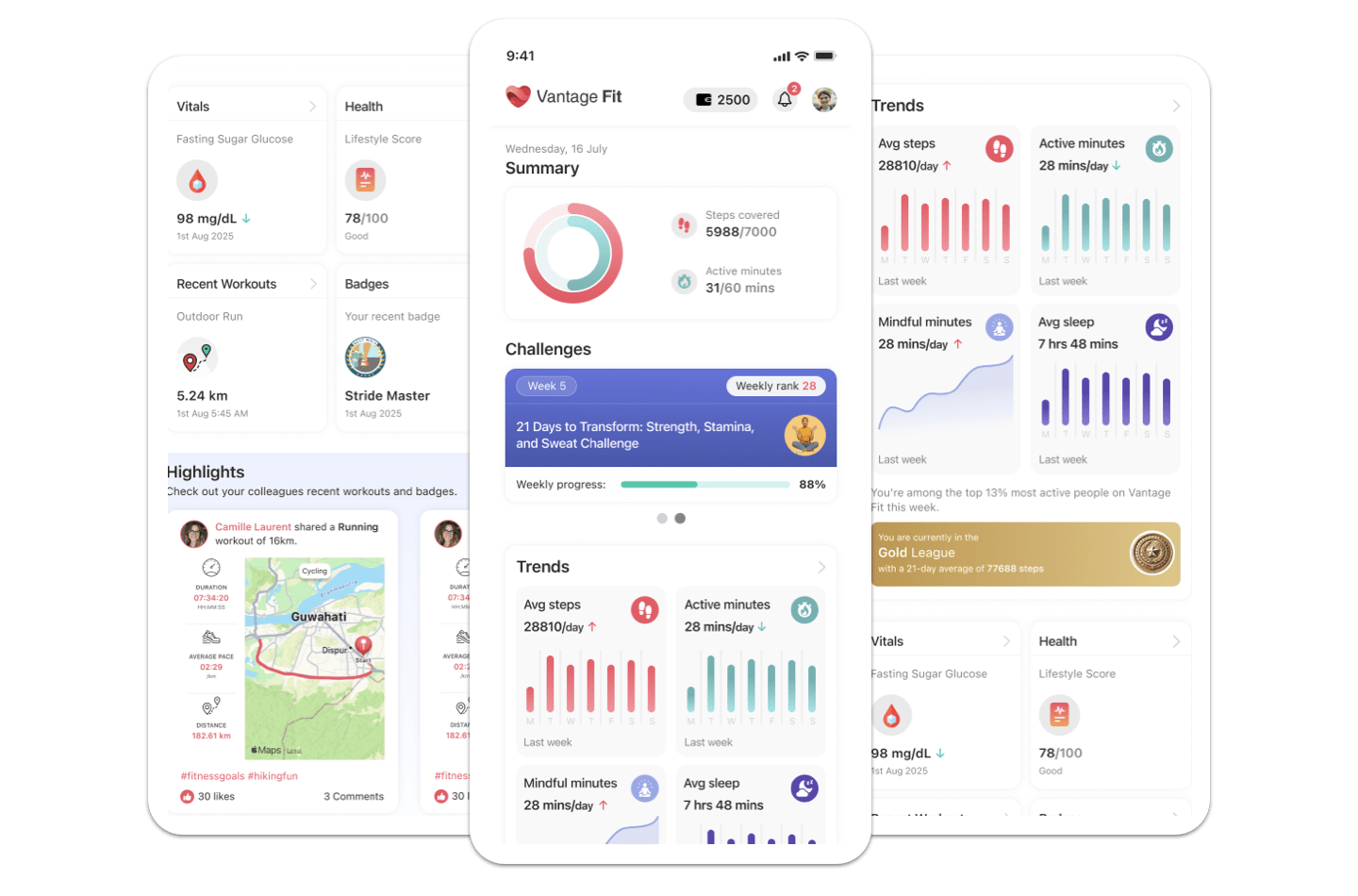
Once goals are set, choose how participants will log progress. Introducing digital platforms like Vantage Fit simplifies tracking and adds gamified incentives.
Vantage Fit automatically syncs participants' activity. Employees can view personal and team standings on live leaderboards, while HR administrators access real-time participation analytics.
Vantage Fit's Active Minutes feature maps stair-climbing sessions against the WHO recommendation of 150 minutes of moderate-intensity activity per week, giving employees tangible feedback on how each flight climbed contributes to overall health.
Workplace wellness research confirms why this visibility matters. Employees who regularly achieve 75 minutes of moderate weekly exercise miss up to 4 fewer sick days per year, translating to meaningful productivity and healthcare savings.
For manual setups, HR can share a centralized spreadsheet for employees to record daily completed flights.
5. Provide clear onboarding guidelines
For the challenge to run smoothly, communicate clear instructions before kickoff:
- Offer a brief intro session explaining how to log stairs on the app or tracking sheet.
- Share guidelines on pacing, warmups, and appropriate footwear.
- Provide motivational tips on integrating stair breaks into regular work routines.
6. Set engaging rules and motivation boosters
Adding variety keeps motivation high throughout the month:
- Daily/Weekly Step Targets: Set clear baseline floor counts for each week.
- Bonus Point Days: Introduce "Take the Stairs After Lunch" or "Double Points Friday."
- Milestone Achievements: Award digital badges at milestone marks (e.g., 50 flights, 100 flights).
Add surprise wild card challenges like "Climb 5 Flights Today" to maintain fresh engagement.
7. Offer meaningful incentives and rewards
Incentives maintain momentum throughout wellness challenges. Meaningful rewards recognize effort and celebrate consistency:
- Trophies or digital certificates for top teams and consistent climbers.
- Fitness accessories (water bottles, fitness bands, or wireless earbuds).
- Wellness perks (gym membership subsidies, healthy lunch vouchers, or extra wellness hours).
- Public recognition in company newsletters and internal social channels.
8. Promote the challenge across multiple channels
A multi-channel communication strategy ensures strong participation:
- Email Teasers: Send announcement emails two weeks prior, followed by weekly leaderboard roundups.
- Internal Channels: Create dedicated Slack or Teams channels for photos, cheers, and daily updates.
- Stairwell Signage: Place motivational posters and floor markers in stairwells to encourage employees at the point of decision.
9. Share ongoing leaderboards and highlights
Regular progress updates keep healthy competition alive:
- Post weekly team standings and top individual climbers.
- Share photos of team stair walks and milestone celebrations.
- Spotlight participants sharing personal energy and fitness improvements.
10. Gather feedback and celebrate achievements
After the challenge concludes, review outcomes and celebrate team success:
- Conduct a brief post-challenge survey to gather feedback on difficulty, format, and platform usability.
- Share aggregate statistics (e.g., "Our team collectively climbed 4,500 flights!").
- Host an award ceremony or casual team social to recognize all participants.
Share the final stats and acknowledge both top performers and most consistent climbers to reinforce an inclusive wellness culture.
Suggested Reading: How to Set Up a Successful Step Challenge at Work
What is a sample 30-day stair climbing plan?
Here is a progressive 4-week structure that scales floor counts gradually. The goal is consistency, not overexertion. Adjust targets according to building height and employee fitness baselines.
Week 1: Build the habit (Days 1 to 7)
Target: 5 to 6 floors per day. Focus on establishing the daily routine.
| Day | Daily target (floors) | Suggested routine |
|---|---|---|
| 1 | 5 | One stair break between morning meetings |
| 2 | 5 | Skip the elevator after lunch |
| 3 | 5 | Two short bursts of 2 to 3 floors each |
| 4 | 5 | Light day. Walking only if tired. |
| 5 | 6 | One sustained climb of 4 floors |
| 6 | 6 | Two short bursts spread through the day |
| 7 | 0 | Active recovery. Optional walk. |
Week 2: Add volume (Days 8 to 14)
Target: 8 to 10 floors per day. Increase frequency while keeping pace steady.
| Day | Daily target (floors) | Suggested routine |
|---|---|---|
| 8 | 8 | Two climbs of 4 floors |
| 9 | 8 | One stair break every two hours |
| 10 | 10 | One sustained climb |
| 11 | 8 | Light day. Walking only. |
| 12 | 10 | Three short bursts |
| 13 | 10 | One sustained climb after lunch |
| 14 | 0 | Active recovery |
Week 3: Build endurance (Days 15 to 21)
Target: 12 to 15 floors per day. Introduce pace variation.
| Day | Daily target (floors) | Suggested routine |
|---|---|---|
| 15 | 12 | Two climbs, one fast and one steady |
| 16 | 12 | Three bursts spread through the day |
| 17 | 15 | One long sustained climb |
| 18 | 10 | Rest. Light stair breaks only. |
| 19 | 15 | Two climbs at different paces |
| 20 | 15 | One climb with intervals (30 seconds fast, 30 seconds steady) |
| 21 | 0 | Active recovery |
Week 4 and Final Stretch: Peak and reflect (Days 22 to 30)
Target: 15 to 20 floors per day. Final push and team reflection.
| Day | Daily target (floors) | Suggested routine |
|---|---|---|
| 22 | 18 | Three climbs through the day |
| 23 | 18 | Two sustained climbs |
| 24 | 20 | Personal best attempt |
| 25 | 15 | Easy day. Walking only if tired. |
| 26 | 20 | Pair climb with a teammate |
| 27 | 18 | One steady climb, one fast |
| 28 | 18 | Two sustained climbs |
| 29 | 20 | Final personal best attempt |
| 30 | 0 | Celebrate. Reflect. Share results. |
Encourage participants to scale targets based on building size. A 3-floor office building requires a different cadence than a 20-floor headquarters.
How to track a 30-day stair climbing challenge
A visible streak is one of the strongest motivators in workplace wellness. Use this grid as a quick reference for participants to mark off each day when they hit their floor target.
Teams can post this tracker on a whiteboard near stairwells or maintain a shared digital version for remote employees.
| Week | Day 1 | Day 2 | Day 3 | Day 4 | Day 5 | Day 6 | Day 7 |
|---|---|---|---|---|---|---|---|
| Week 1 (Days 1 to 7) | ☐ | ☐ | ☐ | ☐ | ☐ | ☐ | ☐ |
| Week 2 (Days 8 to 14) | ☐ | ☐ | ☐ | ☐ | ☐ | ☐ | ☐ |
| Week 3 (Days 15 to 21) | ☐ | ☐ | ☐ | ☐ | ☐ | ☐ | ☐ |
| Week 4 (Days 22 to 28) | ☐ | ☐ | ☐ | ☐ | ☐ | ☐ | ☐ |
| Final stretch (Days 29 to 30) | ☐ | ☐ |
How to use the tracker:
- Mark a box only when the daily floor target is met.
- At the end of each week, count completed days and update team leaderboards.
- Reward consistency over raw totals: a 25-out-of-30-day streak represents greater lifestyle habit formation than isolated high-volume days.
What are creative stair climbing challenge ideas to boost participation?
1. Famous landmarks challenge

Turn stair climbing into a virtual journey where teams climb the equivalent height of world-famous landmarks:
- Eiffel Tower: ~1,660 stairs
- Empire State Building: ~1,576 to 3,200 stairs
- Burj Khalifa: ~2,909 stairs
- Mount Kilimanjaro: ~25,000 stairs (team effort)
Teams can log flights toward these milestone landmarks over 4, 8, or 12 weeks.

To calculate equivalent flights, divide the target stairs by 15 (average steps per flight) and distribute across the challenge timeline.
2. Stairwell takeovers
Decorate stairwells with motivational quotes, facts about stair climbing benefits, or even team cheers. This brings a fun element to the initiative and encourages more stair use.
3. "Caught climbing" spot rewards
Have wellness champions or managers hand out instant perks (healthy snack vouchers or company swag) to employees spotted taking the stairs.
4. Lunchtime stair climbs
Organize occasional lunchtime or after-work events where employees climb stairs together for a set period. Play upbeat music and offer healthy refreshments to create a fun atmosphere.
5. Social media and internal shoutouts
Encourage participants to share updates on social media. Create a dedicated hashtag for them to use along with the update. This creates a sense of community, which further helps with team collaboration at work.
Social Media Hashtag Ideas For Stair Climbing Challenge

Additional incentive ideas
- Healthy Habit Integration: Combine stair goals with hydration tracking or walking meetings.
- Achievement Badges: Award physical or digital milestone pins to celebrate personal records.
Offer micro-incentives for weekly consistency, top team progress, and best improvement to keep everyone engaged regardless of baseline fitness.
How does challenge-based wellness drive employee engagement?
LeAnn Smith, a certified Health & Nutrition Coach with over 14 years of corporate HR experience, explains why competitive formats like stair climbing challenges work where general wellness advice often falls short:
"Challenges are a great way because all of us are a little competitive. A step challenge is always a great one: it's easy, it's easy to track, and it's an easy way for people to start getting into it."
— LeAnn Smith, Health & Nutrition Coach | Listen to the full episode
How can employees increase stair climbing endurance safely?
 Physically inactive individuals may struggle to take the stairs. They may feel breathless or tired quickly. Speaking from personal experience, there was a time when I used to get breathless after taking three flights of stairs. The reason for this was that I was physically inactive and led a sedentary lifestyle.
I somehow decided to join the CrossFit community, and within just a few weeks, I realized the breathlessness was gone.
P.S. If you have the same experience, it's time to take up an active lifestyle.
Until then, to participate in a stair climbing challenge, follow these tricks below:
- Pace Yourself: Begin with a slow, controlled cadence rather than sprinting.
- Control Your Breath: Inhale through the nose and exhale rhythmically through the mouth.
- Use Landings for Brief Rests: Pause for 5 to 10 seconds between floors if your heart rate spikes.
- Wear Supportive Footwear: Wear cushioned, supportive shoes to minimize impact on knees and ankles.
- Engage the Full Foot: Place the entire foot on the step rather than just the toes to engage glutes and protect calves.
What is the environmental impact of taking the stairs at work?
Taking the stairs at work or anywhere else, without any doubt, has health benefits. This activity also contributes to a greener and more sustainable future. As part of the challenge, participants will be ditching elevators and taking the stairs to hit the goal.
Elevators represent a significant portion of commercial building energy consumption. By encouraging hundreds of employees to take the stairs daily, organizations reduce peak power demand and actively advance green office practices.
Wrapping up: Help your workforce move, one step at a time
Incorporating corporate wellness programs like stair climbing challenges transforms simple daily routines into powerful health-building habits. Adding gamified tracking, team camaraderie, and leadership participation turns taking the stairs into an energizing workplace cultural norm.
Wellness platforms like Vantage Fit make running virtual wellness challenges simple with automated activity tracking, custom challenge parameters, and insightful workforce analytics.
Ready to level up employee wellness? Schedule a Vantage Fit demo to see how gamified challenges keep employees healthy and engaged.
Frequently Asked Questions
Can I climb steps as a daily workout if I am a beginner?
Yes. Beginners can start with 3 to 5 flights of stairs daily at a comfortable, steady pace. Pacing yourself, stepping with the full foot, and taking elevator rides down reduce joint strain while safely building cardiovascular stamina.
Why is stair climbing effective for different roles like corporate professionals, freelancers, and chefs?
Stair climbing serves diverse work demands. It breaks up sedentary sitting for corporate professionals, offers accessible home micro-workouts for freelancers, and activates postural glute muscles to relieve static standing strain for chefs and shift workers.
How many flights of stairs should employees climb per day during a challenge?
Beginners should start with 4 to 6 flights per day spread across morning and afternoon breaks. As endurance develops, employees can gradually progress to 12 to 20 flights daily over the course of a 30-day challenge.
How many calories does climbing stairs burn compared to walking?
Stair climbing burns approximately 8 to 11 calories per minute, which is roughly 2 to 3 times more energy expenditure than walking at a moderate pace on flat ground.
How can remote and hybrid employees participate in a workplace stair climbing challenge?
Remote and hybrid workers can log flights using home staircases, apartment building stairs, outdoor public steps, or stepper workouts tracked through the Vantage Fit mobile app.
Is stair climbing safe for employees with knee or joint discomfort?
Employees with mild joint discomfort should focus on climbing up (which is low-impact) and taking the elevator down to reduce joint pressure. Anyone with acute joint issues should consult a physician before increasing stair volume.